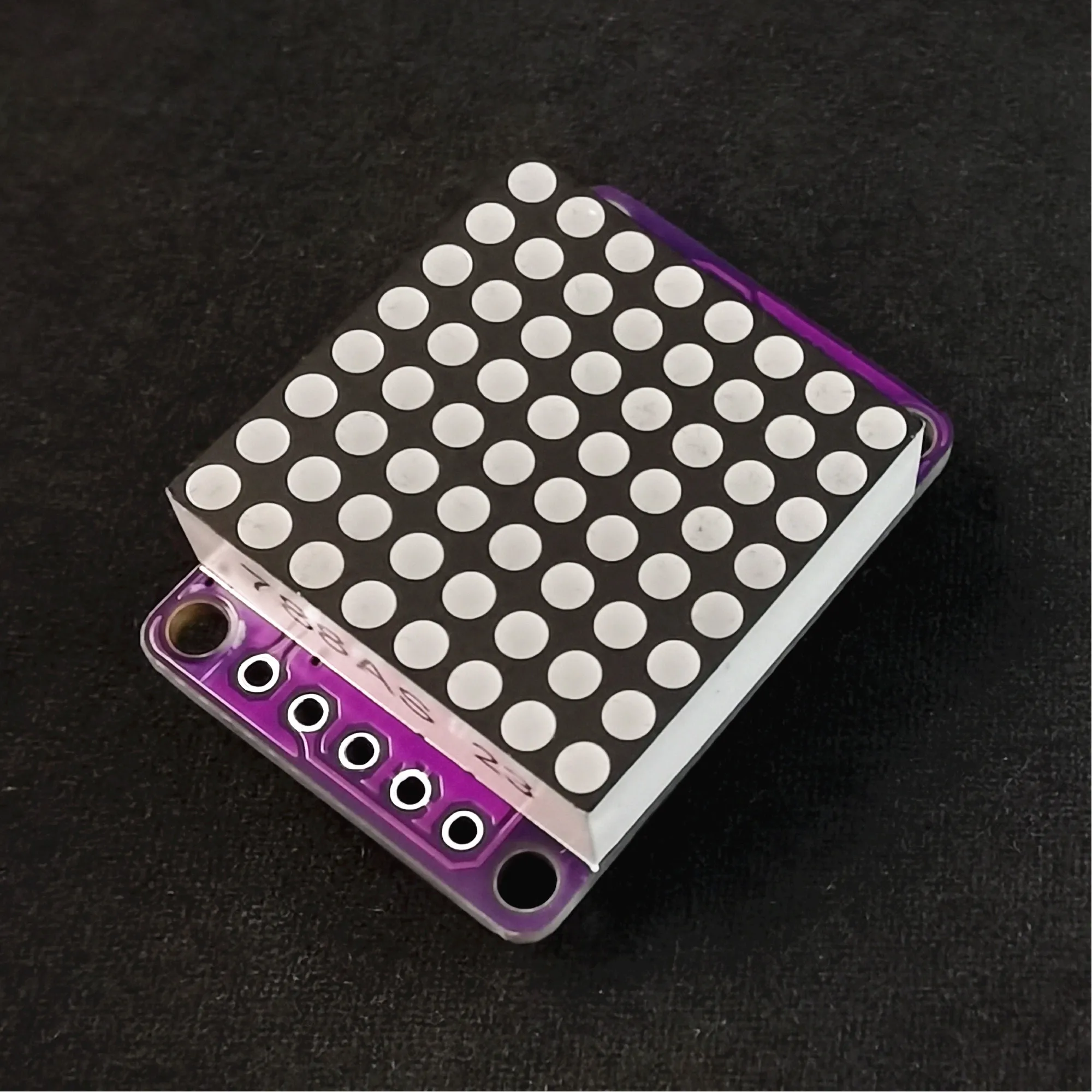
8x8 MAX7219 적색/청색/녹색/백색 도트 LED 매트릭스 MCU 디스플레이 제어 모듈 5V 인터페이스 출력 입력 공통 음극 0.7인치 8*8
· 단일 모듈로 8*8 공통 캐소드 도트 매트릭스를 구동할 수 있습니다.
· 모듈 작동 전압: 5V
· 모듈 크기: 길이 3.2cm x 너비 3.2cm x 높이 1.3cm
· 직경 3mm의 고정 나사 구멍 4개가 있으며, M3 구리 기둥으로 고정할 수 있습니다.
· 입/출력 인터페이스를 갖추고 있어 여러 모듈을 직렬로 연결하여 사용할 수 있습니다.
배선 방법:
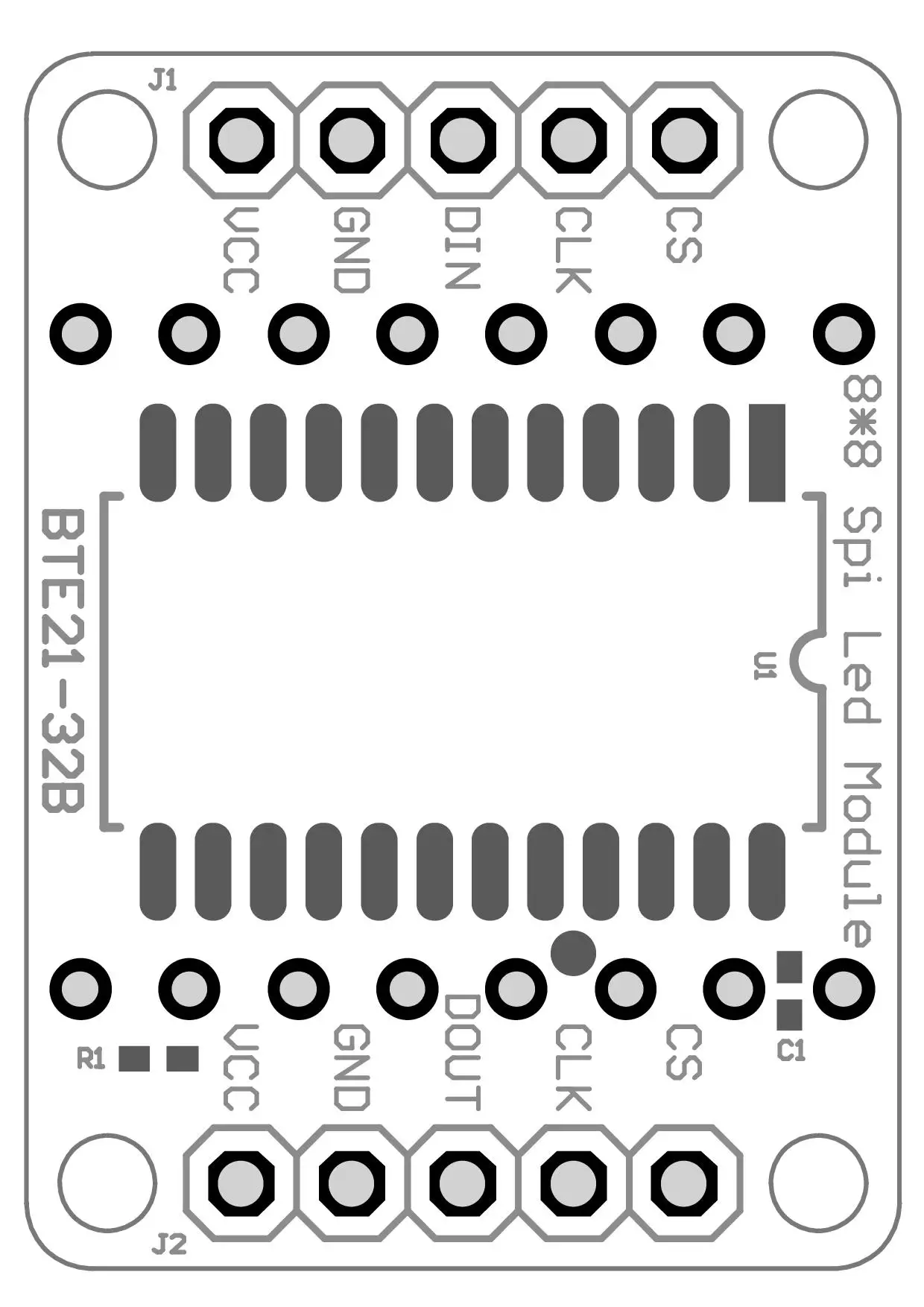
모듈의 왼쪽은 입력 포트이고, 오른쪽은 출력 포트입니다.
단일 모듈을 제어할 때는 입력 포트를 CPU에 연결하기만 하면 됩니다.
여러 모듈을 직렬로 연결할 때는 첫 번째 모듈의 입력을 CPU에 연결하고, 출력을 두 번째 모듈의 입력에 연결하고, 두 번째 모듈의 출력을 세 번째 모듈의 입력에 연결하는 식으로 연결합니다.
51 마이크로컨트롤러를 예로 들면 다음과 같습니다.
· VCC → 5V
· GND → GND
· DIN → P20
· CS → P21
· CLK → P22
주의 사항:
· VCC와 GND를 반대로 연결하면 칩이 손상될 수 있으므로 절대 반대로 연결하지 마십시오!
· 51 마이크로컨트롤러의 P0 포트를 사용하여 제어할 때는 풀업 저항을 연결해야 하며, 권장 저항값은 4.7kΩ~10kΩ입니다.
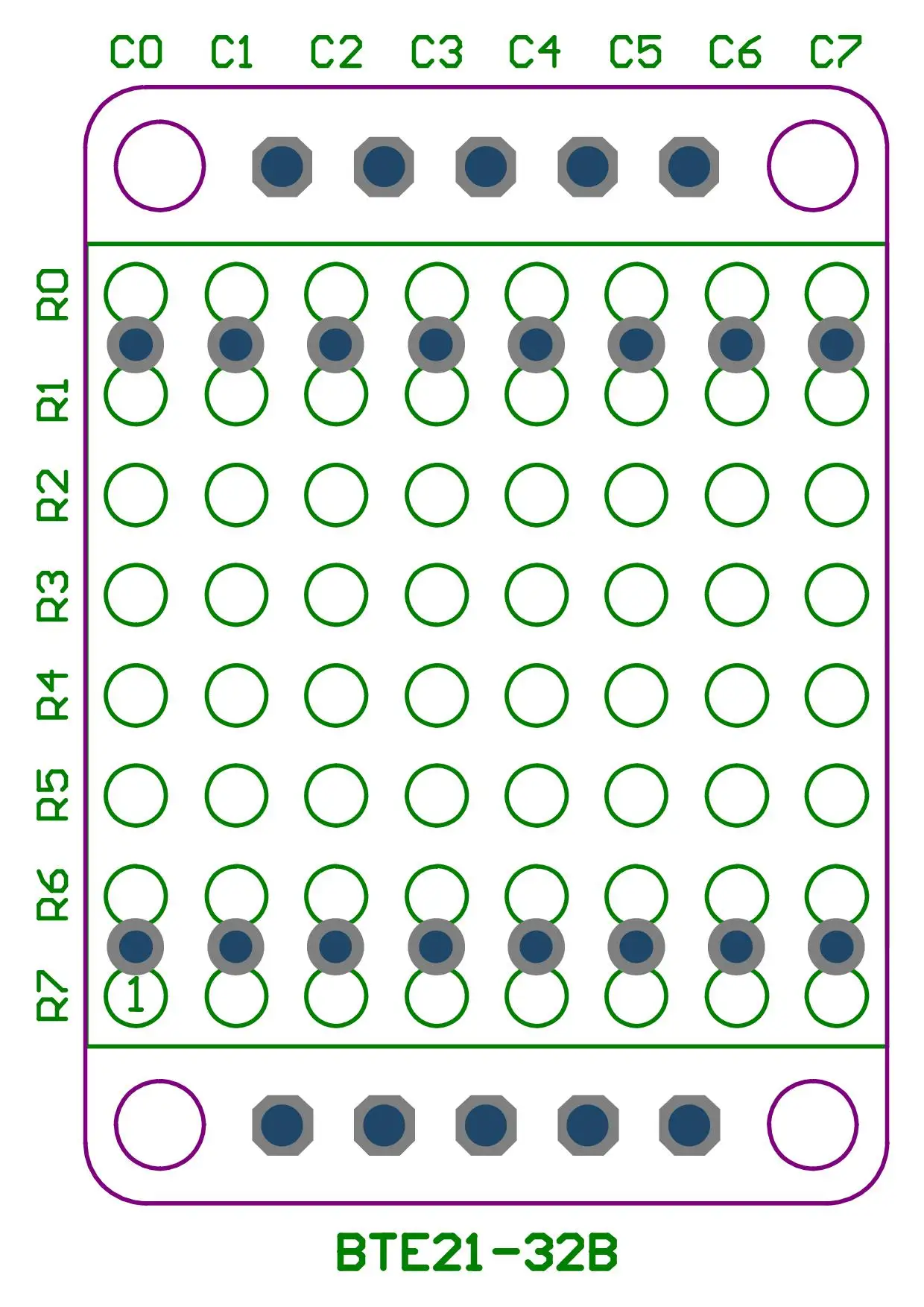
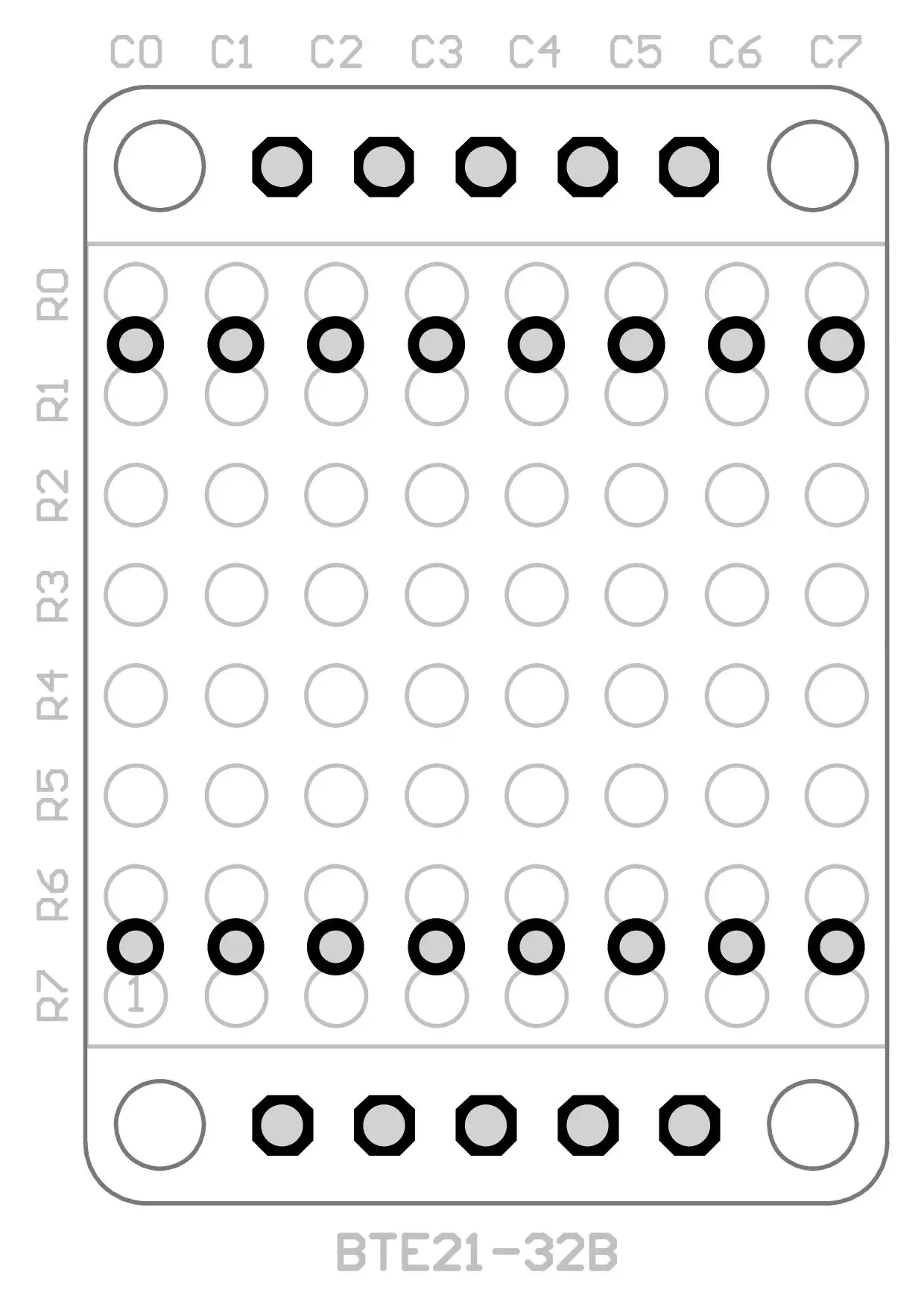
· 도트 매트릭스를 원형 홀 홀더에 먼저 삽입한 후, 원형 홀 홀더를 PCB 기판에 삽입하여 납땜하십시오. 도트 매트릭스의 글자가 있는 면을 자신 쪽으로 향하게 하고, 이쪽 면의 핀 순서는 왼쪽에서 오른쪽으로 123456입니다. PCB 기판의 첫 번째 핀은 정사각형 모양의 납땜 패드입니다!
아래 회로 출처: 만드는 방법 링크를 참고하세요.

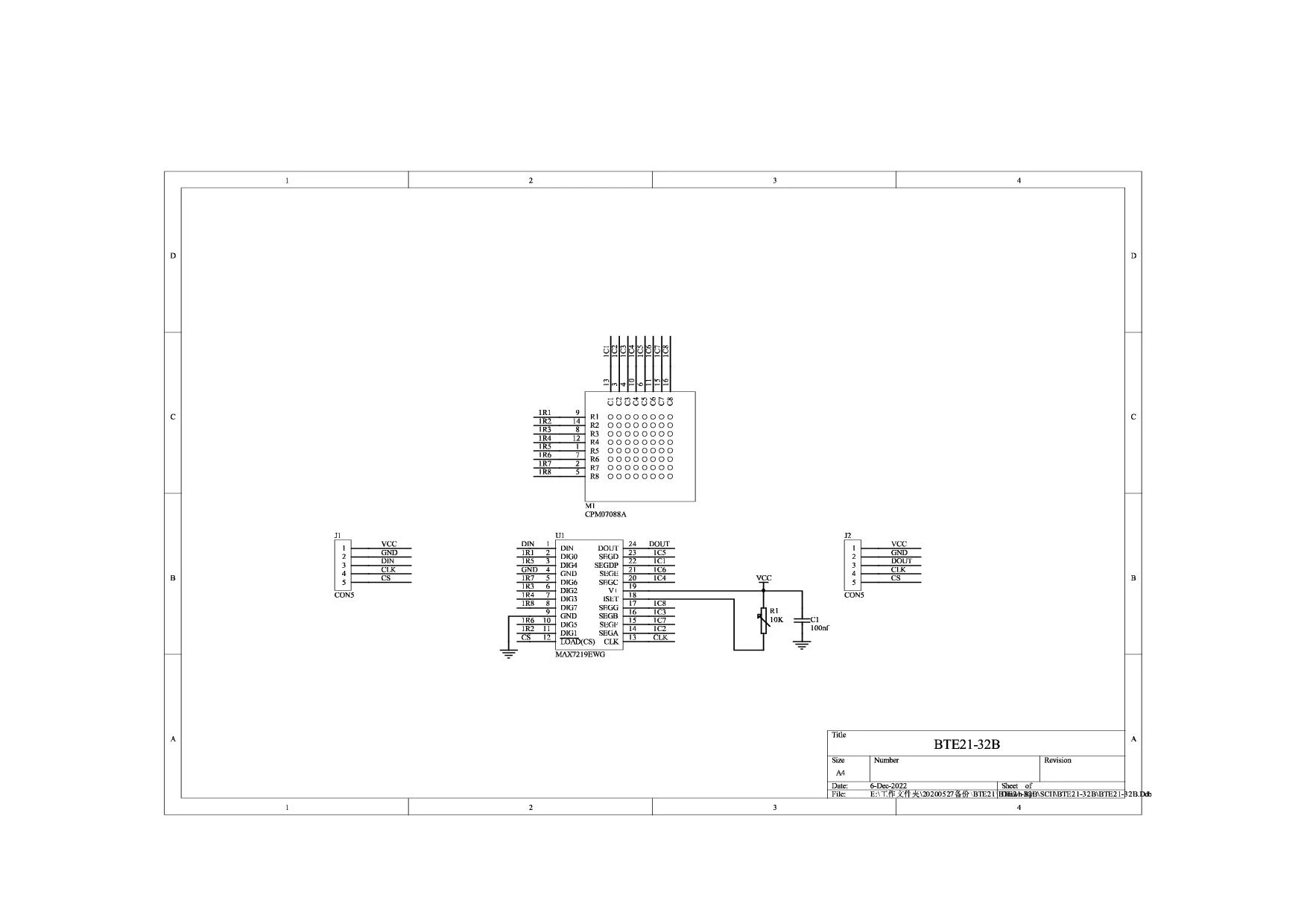

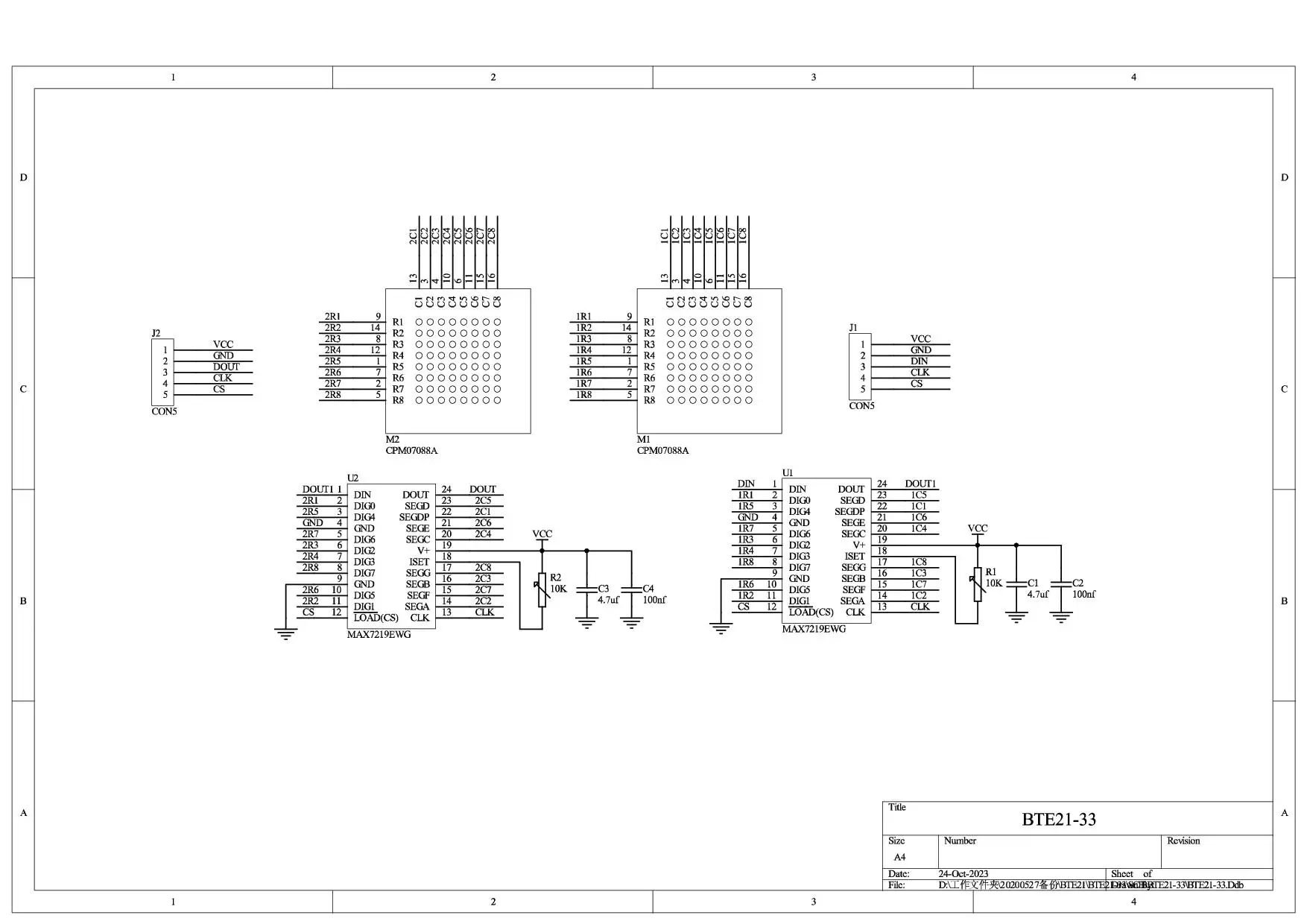
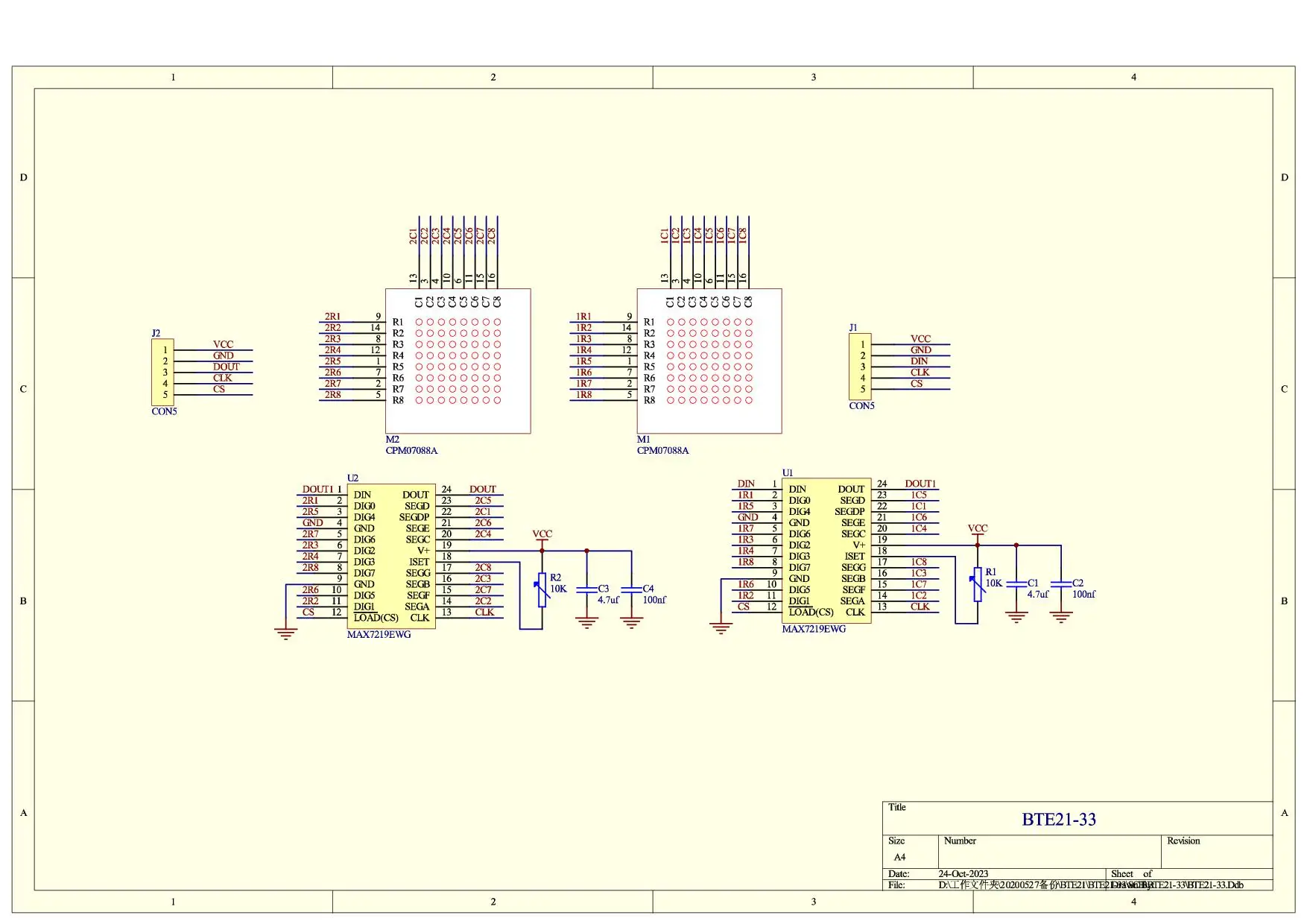
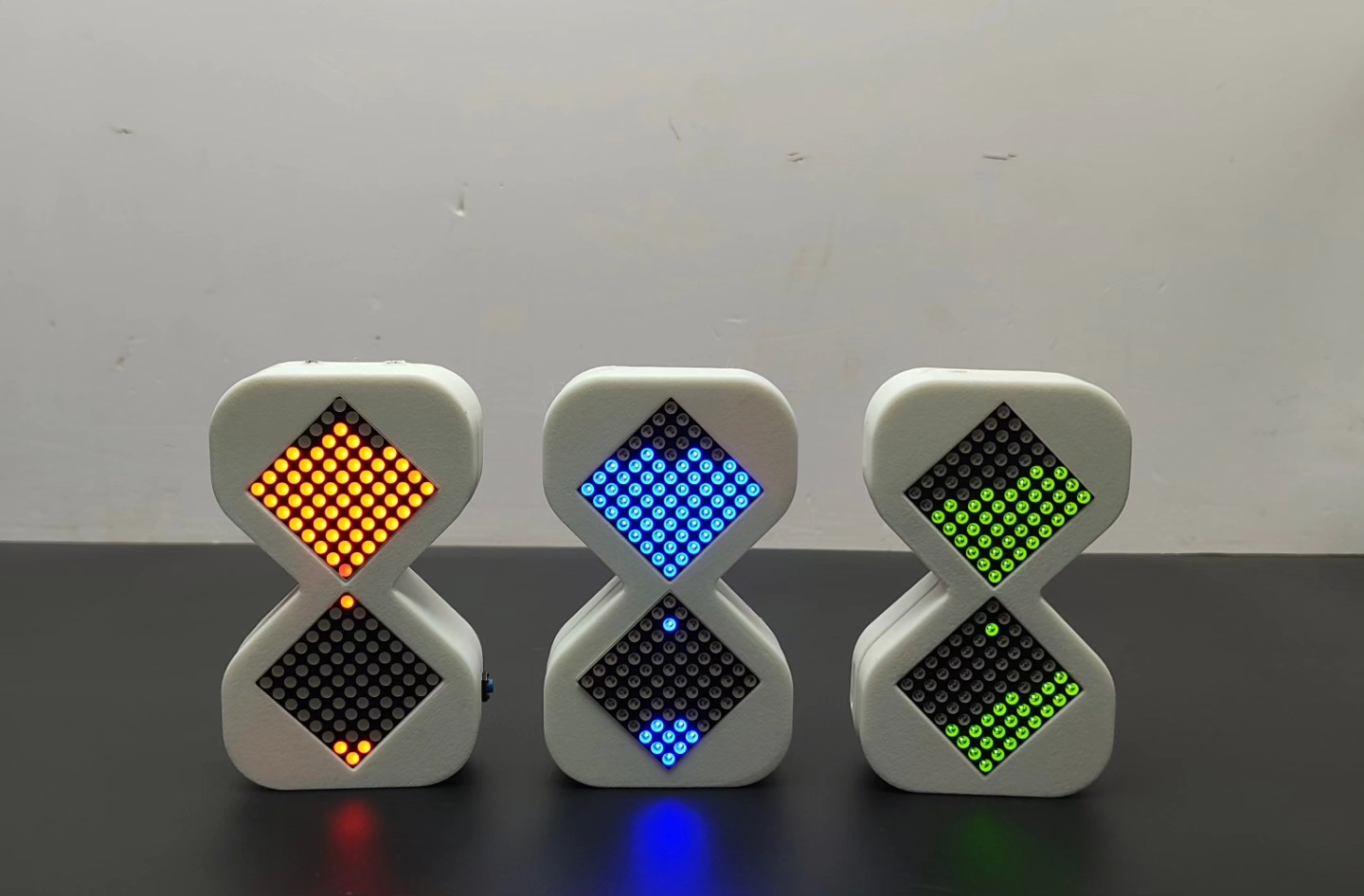
코드는 아래에 올린다. 코드 출처를 참고하세요.
코드 깃허브는 이곳을 참고하세요.
//code credits Fabrizio Branca

//EDISON SCIENCE CORNER

#include "Arduino.h"
#include "LedControl.h"
#include "Delay.h"

#define  MATRIX_A  1
#define MATRIX_B  0

// Values are 260/330/400
#define ACC_THRESHOLD_LOW 300
#define ACC_THRESHOLD_HIGH 360

// Matrix
#define PIN_DATAIN 5
#define PIN_CLK 4
#define PIN_LOAD 6

// Accelerometer
#define PIN_X A1
#define PIN_Y A2

// Rotary Encoder
#define PIN_ENC_1 3
#define PIN_ENC_2 2
#define PIN_ENC_BUTTON 7

#define PIN_BUZZER 14

// This takes into account how the matrixes are mounted
#define ROTATION_OFFSET 90

// in milliseconds
#define DEBOUNCE_THRESHOLD 500

#define DELAY_FRAME 100

#define DEBUG_OUTPUT 1

#define MODE_HOURGLASS 0
#define MODE_SETMINUTES 1
#define MODE_SETHOURS 2

byte delayHours = 0;
byte delayMinutes = 1;
int mode = MODE_HOURGLASS;
int gravity;
LedControl lc = LedControl(PIN_DATAIN, PIN_CLK, PIN_LOAD, 2);
NonBlockDelay d;
int resetCounter = 0;
bool alarmWentOff = false;


/**
 * Get delay between particle drops (in seconds)
 */
long getDelayDrop() {
  // since we have exactly 60 particles we don't have to multiply by 60 and then divide by the number of particles again :)
  return delayMinutes + delayHours * 60;
}


#if DEBUG_OUTPUT
void printmatrix() {
  Serial.println(" 0123-4567 ");
  for (int y = 0; y<8; y++) {
    if (y == 4) {
      Serial.println("|----|----|");
    }
    Serial.print(y);
    for (int x = 0; x<8; x++) {
      if (x == 4) {
        Serial.print("|");
      }
      Serial.print(lc.getXY(0,x,y) ? "X" :" ");
    }
    Serial.println("|");
  }
  Serial.println("-----------");
}
#endif


coord getDown(int x, int y) {
  coord xy;
  xy.x = x-1;
  xy.y = y+1;
  return xy;
}
coord getLeft(int x, int y) {
  coord xy;
  xy.x = x-1;
  xy.y = y;
  return xy;
}
coord getRight(int x, int y) {
  coord xy;
  xy.x = x;
  xy.y = y+1;
  return xy;
}


bool canGoLeft(int addr, int x, int y) {
  if (x == 0) return false; // not available
  return !lc.getXY(addr, getLeft(x, y)); // you can go there if this is empty
}
bool canGoRight(int addr, int x, int y) {
  if (y == 7) return false; // not available
  return !lc.getXY(addr, getRight(x, y)); // you can go there if this is empty
}
bool canGoDown(int addr, int x, int y) {
  if (y == 7) return false; // not available
  if (x == 0) return false; // not available
  if (!canGoLeft(addr, x, y)) return false;
  if (!canGoRight(addr, x, y)) return false;
  return !lc.getXY(addr, getDown(x, y)); // you can go there if this is empty
}


void goDown(int addr, int x, int y) {
  lc.setXY(addr, x, y, false);
  lc.setXY(addr, getDown(x,y), true);
}
void goLeft(int addr, int x, int y) {
  lc.setXY(addr, x, y, false);
  lc.setXY(addr, getLeft(x,y), true);
}
void goRight(int addr, int x, int y) {
  lc.setXY(addr, x, y, false);
  lc.setXY(addr, getRight(x,y), true);
}


int countParticles(int addr) {
  int c = 0;
  for (byte y=0; y<8; y++) {
    for (byte x=0; x<8; x++) {
      if (lc.getXY(addr, x, y)) {
        c++;
      }
    }
  }
  return c;
}


bool moveParticle(int addr, int x, int y) {
  if (!lc.getXY(addr,x,y)) {
    return false;
  }

  bool can_GoLeft = canGoLeft(addr, x, y);
  bool can_GoRight = canGoRight(addr, x, y);

  if (!can_GoLeft && !can_GoRight) {
    return false; // we're stuck
  }

  bool can_GoDown = canGoDown(addr, x, y);

  if (can_GoDown) {
    goDown(addr, x, y);
  } else if (can_GoLeft&& !can_GoRight) {
    goLeft(addr, x, y);
  } else if (can_GoRight && !can_GoLeft) {
    goRight(addr, x, y);
  } else if (random(2) == 1) { // we can go left and right, but not down
    goLeft(addr, x, y);
  } else {
    goRight(addr, x, y);
  }
  return true;
}


void fill(int addr, int maxcount) {
  int n = 8;
  byte x,y;
  int count = 0;
  for (byte slice = 0; slice < 2*n-1; ++slice) {
    byte z = slice<n ? 0 : slice-n + 1;
    for (byte j = z; j <= slice-z; ++j) {
      y = 7-j;
      x = (slice-j);
      lc.setXY(addr, x, y, (++count <= maxcount));
    }
  }
}


/**
 * Detect orientation using the accelerometer
 *
 *     | up | right | left | down |
 * --------------------------------
 * 400 |    |       | y    | x    |
 * 330 | y  | x     | x    | y    |
 * 260 | x  | y     |      |      |
 */
int getGravity() {
  int x = analogRead(PIN_X);
  int y = analogRead(PIN_Y);
  if (y < ACC_THRESHOLD_LOW)  { return 0;   }
  if (x > ACC_THRESHOLD_HIGH) { return 90;  }
  if (y > ACC_THRESHOLD_HIGH) { return 180; }
  if (x < ACC_THRESHOLD_LOW)  { return 270; }
}


int getTopMatrix() {
  return (getGravity() == 90) ? MATRIX_A : MATRIX_B;
}
int getBottomMatrix() {
  return (getGravity() != 90) ? MATRIX_A : MATRIX_B;
}


void resetTime() {
  for (byte i=0; i<2; i++) {
    lc.clearDisplay(i);
  }
  fill(getTopMatrix(), 60);
  d.Delay(getDelayDrop() * 1000);
}


/**
 * Traverse matrix and check if particles need to be moved
 */
bool updateMatrix() {
  int n = 8;
  bool somethingMoved = false;
  byte x,y;
  bool direction;
  for (byte slice = 0; slice < 2*n-1; ++slice) {
    direction = (random(2) == 1); // randomize if we scan from left to right or from right to left, so the grain doesn't always fall the same direction
    byte z = slice<n ? 0 : slice-n + 1;
    for (byte j = z; j <= slice-z; ++j) {
      y = direction ? (7-j) : (7-(slice-j));
      x = direction ? (slice-j) : j;
      // for (byte d=0; d<2; d++) { lc.invertXY(0, x, y); delay(50); }
      if (moveParticle(MATRIX_B, x, y)) {
        somethingMoved = true;
      };
      if (moveParticle(MATRIX_A, x, y)) {
        somethingMoved = true;
      }
    }
  }
  return somethingMoved;
}


/**
 * Let a particle go from one matrix to the other
 */
boolean dropParticle() {
  if (d.Timeout()) {
    d.Delay(getDelayDrop() * 1000);
    if (gravity == 0 || gravity == 180) {
      if ((lc.getRawXY(MATRIX_A, 0, 0) && !lc.getRawXY(MATRIX_B, 7, 7)) ||
          (!lc.getRawXY(MATRIX_A, 0, 0) && lc.getRawXY(MATRIX_B, 7, 7))
      ) {
        // for (byte d=0; d<8; d++) { lc.invertXY(0, 0, 7); delay(50); }
        lc.invertRawXY(MATRIX_A, 0, 0);
        lc.invertRawXY(MATRIX_B, 7, 7);
        tone(PIN_BUZZER, 440, 10);
        return true;
      }
    }
  }
  return false;
}


void alarm() {
  for (int i=0; i<5; i++) {
    tone(PIN_BUZZER, 440, 200);
    delay(1000);
  }
}


void resetCheck() {
  int z = analogRead(A3);
  if (z > ACC_THRESHOLD_HIGH || z < ACC_THRESHOLD_LOW) {
    resetCounter++;
    Serial.println(resetCounter);
  } else {
    resetCounter = 0;
  }
  if (resetCounter > 20) {
    Serial.println("RESET!");
    resetTime();
    resetCounter = 0;
  }
}


void displayLetter(char letter, int matrix) {
  // Serial.print("Letter: ");
  // Serial.println(letter);
  lc.clearDisplay(matrix);
  lc.setXY(matrix, 1,4, true);
  lc.setXY(matrix, 2,3, true);
  lc.setXY(matrix, 3,2, true);
  lc.setXY(matrix, 4,1, true);

  lc.setXY(matrix, 3,6, true);
  lc.setXY(matrix, 4,5, true);
  lc.setXY(matrix, 5,4, true);
  lc.setXY(matrix, 6,3, true);

  if (letter == 'M') {
    lc.setXY(matrix, 4,2, true);
    lc.setXY(matrix, 4,3, true);
    lc.setXY(matrix, 5,3, true);
  }
  if (letter == 'H') {
    lc.setXY(matrix, 3,3, true);
    lc.setXY(matrix, 4,4, true);
  }
}


void renderSetMinutes() {
  fill(getTopMatrix(), delayMinutes);
  displayLetter('M', getBottomMatrix());
}
void renderSetHours() {
  fill(getTopMatrix(), delayHours);
  displayLetter('H', getBottomMatrix());
}


void knobClockwise() {
  Serial.println("Clockwise");
  if (mode == MODE_SETHOURS) {
    delayHours = constrain(delayHours+1, 0, 64);
    renderSetHours();
  } else if(mode == MODE_SETMINUTES) {
    delayMinutes = constrain(delayMinutes+1, 0, 64);
    renderSetMinutes();
  }
  Serial.print("Delay: ");
  Serial.println(getDelayDrop());
}
void knobCounterClockwise() {
  Serial.println("Counterclockwise");
  if (mode == MODE_SETHOURS) {
    delayHours = constrain(delayHours-1, 0, 64);
    renderSetHours();
  } else if (mode == MODE_SETMINUTES) {
    delayMinutes = constrain(delayMinutes-1, 0, 64);
    renderSetMinutes();
  }
  Serial.print("Delay: ");
  Serial.println(getDelayDrop());
}


volatile int lastEncoded = 0;
volatile long encoderValue = 0;
long lastencoderValue = 0;
long lastValue = 0;
void updateEncoder() {
  int MSB = digitalRead(PIN_ENC_1); //MSB = most significant bit
  int LSB = digitalRead(PIN_ENC_2); //LSB = least significant bit

  int encoded = (MSB << 1) |LSB; //converting the 2 pin value to single number
  int sum  = (lastEncoded << 2) | encoded; //adding it to the previous encoded value

  if(sum == 0b1101 || sum == 0b0100 || sum == 0b0010 || sum == 0b1011) encoderValue--;
  if(sum == 0b1110 || sum == 0b0111 || sum == 0b0001 || sum == 0b1000) encoderValue++;

  // Serial.print("Value: ");
  // Serial.println(encoderValue);
  if ((encoderValue % 4) == 0) {
    int value = encoderValue / 4;
    if (value > lastValue) knobClockwise();
    if (value < lastValue) knobCounterClockwise();
    lastValue = value;
  }
  lastEncoded = encoded; //store this value for next time
}


/**
 * Button callback (incl. software debouncer)
 * This switches between the modes (normal, set minutes, set hours)
 */
volatile unsigned long lastButtonPushMillis;
void buttonPush() {
  if((long)(millis() - lastButtonPushMillis) >= DEBOUNCE_THRESHOLD) {
    mode = (mode+1) % 3;
    Serial.print("Switched mode to: ");
    Serial.println(mode);
    lastButtonPushMillis = millis();

    if (mode == MODE_SETMINUTES) {
      lc.backup(); // we only need to back when switching from MODE_HOURGLASS->MODE_SETMINUTES
      renderSetMinutes();
    }
    if (mode == MODE_SETHOURS) {
      renderSetHours();
    }
    if (mode == MODE_HOURGLASS) {
      lc.clearDisplay(0);
      lc.clearDisplay(1);
      lc.restore();
      resetTime();
    }
  }
}


/**
 * Setup
 */
void setup() {
  Serial.begin(9600);

  // while (!Serial) {
  //   ; // wait for serial port to connect. Needed for native USB
  // }

  // setup rotary encoder
  pinMode(PIN_ENC_1, INPUT);
  pinMode(PIN_ENC_2, INPUT);
  pinMode(PIN_ENC_BUTTON, INPUT);
  digitalWrite(PIN_ENC_1, HIGH); //turn pullup resistor on
  digitalWrite(PIN_ENC_2, HIGH); //turn pullup resistor on
  digitalWrite(PIN_ENC_BUTTON, HIGH); //turn pullup resistor on
  attachInterrupt(digitalPinToInterrupt(PIN_ENC_1), updateEncoder, CHANGE);
  attachInterrupt(digitalPinToInterrupt(PIN_ENC_2), updateEncoder, CHANGE);
  attachInterrupt(digitalPinToInterrupt(PIN_ENC_BUTTON), buttonPush, RISING);

  // Serial.println(digitalPinToInterrupt(PIN_ENC_1));
  // Serial.println(digitalPinToInterrupt(PIN_ENC_2));
  // Serial.println(digitalPinToInterrupt(PIN_ENC_BUTTON));

  randomSeed(analogRead(A0));

  // init displays
  for (byte i=0; i<2; i++) {
    lc.shutdown(i,false);
    lc.setIntensity(i,0);
  }

  resetTime();
}


/**
 * Main loop
 */
void loop() {
  delay(DELAY_FRAME);

  // update the driver's rotation setting. For the rest of the code we pretend "down" is still 0,0 and "up" is 7,7
  gravity = getGravity();
  lc.setRotation((ROTATION_OFFSET + gravity) % 360);

  // handle special modes
  if (mode == MODE_SETMINUTES) {
    renderSetMinutes(); return;
  } else if (mode == MODE_SETHOURS) {
    renderSetHours(); return;
  }

  // resetCheck(); // reset now happens when pushing a button
  bool moved = updateMatrix();
  bool dropped = dropParticle();

  // alarm when everything is in the bottom part
  if (!moved && !dropped && !alarmWentOff && (countParticles(getTopMatrix()) == 0)) {
    alarmWentOff = true;
    alarm();
  }
  // reset alarm flag next time a particle was dropped
  if (dropped) {
    alarmWentOff = false;
  }
}'개발자 > 부품' 카테고리의 다른 글
| 5V 3.1A USB C타입 승압 충방전 통합 모듈 (0) | 2026.05.27 |
|---|---|
| Type-C 3A 폴리머 리튬 배터리 보드 (IP2312) 실전 가이드 (0) | 2026.05.27 |
| LED 도트 매트릭스 모듈 MAX7219 디스플레이 모듈 (0) | 2026.05.25 |
| ESP32 USB + LiPo 배터리 충전회로 (0) | 2026.05.25 |
| PY32F002A 시리즈 마이크로컨트롤러 Dev Resource (0) | 2026.05.21 |
| USB Type-C 커넥터 브레이크아웃 보드 (0) | 2026.05.21 |
| STmicro VL53L5CX 고급 ToF(Time-of-Flight) 다중 영역 거리 측정 센서 (0) | 2026.05.20 |
| QCC74xM EVK는 Wi-Fi 6, 블루투스 5.4 및 802.15.4 연결 기능을 제공 (0) | 2026.05.20 |
취업, 창업의 막막함, 외주 관리, 제품 부재!
당신의 고민은 무엇입니까? 현실과 동떨어진 교육, 실패만 반복하는 외주 계약,
아이디어는 있지만 구현할 기술이 없는 막막함.
우리는 알고 있습니다. 문제의 원인은 '명확한 학습, 실전 경험과 신뢰할 수 있는 기술력의 부재'에서 시작됩니다.
이제 고민을 멈추고, 캐어랩을 만나세요!
코딩(펌웨어), 전자부품과 디지털 회로설계, PCB 설계 제작, 고객(시장/수출) 발굴과 마케팅 전략으로 당신을 지원합니다.
제품 설계의 고수는 성공이 만든 게 아니라 실패가 만듭니다. 아이디어를 양산 가능한 제품으로!
귀사의 제품을 만드세요. 교육과 개발 실적으로 신뢰할 수 있는 파트너를 확보하세요.
캐어랩


